3Q In Review: A Quarter of Crosscurrents | Steve Henderly, CFA
Away from the Magnificent 7, September was painful for diversified investors across most asset classes including stocks, bonds, and commodities eroding much of the incremental progress enjoyed during July and August. The divergence was striking: the equal-weight S&P 500 fell 4.8% for the month, while the more widely followed cap-weighted index declined just 0.4%, supported by technology and the largest growth companies. The Magnificent 7 gained roughly 11% during the quarter, with Microsoft, Apple, and Meta accounting for the overwhelming majority of that advance. Energy provided one of the few other bright spots, benefiting from the sharp rise in oil prices.
The cap-weighted S&P 500 gained 2.8% for the quarter, bringing its year-to-date advance to roughly 12%. Beneath the surface, the quarter looked considerably less impressive. Areas that were providing leadership through August softened and diversified portfolios drifting off a touch for the quarter. Year-to-date, the stock portion of client portfolios is on par with the S&P 500.
With rates climbing swiftly in September, bonds offered little refuge. The Bloomberg U.S. Aggregate Index declined roughly 3% during the quarter as Treasury yields surged, producing the broad bond market’s worst quarter since 2022. It was a rare instance where portfolios with greater exposure to traditional bonds actually suffered slightly more than those with more stock exposure.
There’s plenty that can be written to recap what moved markets throughout the quarter. We likened July to the movie “Groundhog Day”, as inflation pressures resurfaced, the conflict in the Middle East, and tariffs returned to the headlines. Investors largely looked through those concerns as corporate earnings remained exceptionally strong, economic growth held up, and enthusiasm surrounding artificial intelligence continued to support an enormous capital investment cycle.
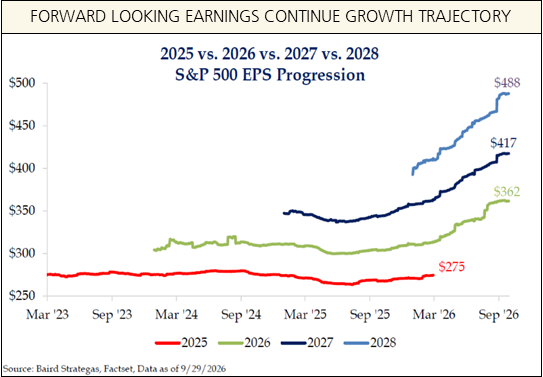
August brought more of the same, but with an important twist. Stocks continued to push higher even as bond yields began to climb more noticeably. “Fabulous Earnings Momentum” (FEMO) among corporations continued to exceed expectations, providing fundamental support for stocks even as interest rates became less accommodating.
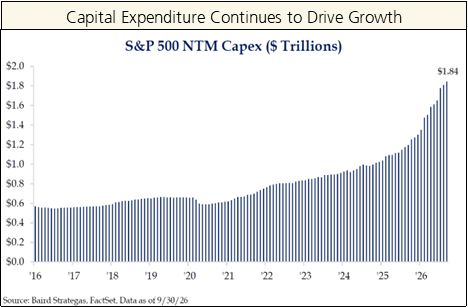
The current economy continues to distinguish itself from a typical expansion. Rather than relying primarily on consumer spending, an extraordinary amount of growth is coming from business investment in technology, equipment, infrastructure, and other capital projects. In September, however, the quarter’s various storylines began converging. Long term interest rates shifted into a higher gear. Oil breached $100 per barrel. Mortgage rates moved above 7% for the first time in more than 20 years. The Federal Reserve officially reversed course and raised short-term interest rates for the first time in several years seeking to reinforce its commitment to price stability as part of its dual mandate (the other mandate being full employment).
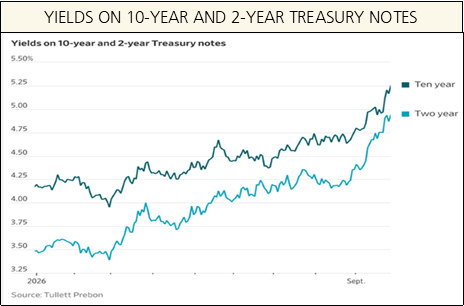
The third quarter was less about any new problem and more about several old ones becoming increasingly difficult for the broad market to dismiss. The most important development is probably not the Fed’s decision to raise short-term interest rates but rather what occurred independently in the bond market. Longer term Treasury yields continued climbing as investors wrestled with persistent inflation, enormous government borrowing needs, and uncertainty over where interest rates ultimately need to settle.
Whether this combination merely slows the expansion or ultimately exposes more serious cracks is becoming the defining question for markets during the final months of 2026.
Despite a challenging third quarter, the broader stock market remains up double digits year to date, with small-cap stocks leading the way. In a midterm election year, historically known for its share of bumps and uncertainty, these results are a welcome reminder of the market’s resilience. While quarterly performance can be frustrating, the bigger picture remains encouraging and a good reminder to maintain perspective and stay focused on the long term.
4Q Outlook: Watching for Cracks
We enter the final quarter of 2026 with interest rates at levels not seen in decades, a Federal Reserve back in tightening mode, and an economy that continues to show surprising resilience.
The spotlight is on bond yields as the 10 year U.S. Treasury yield briefly climbed above 5.3% on the final day of the third quarter (9/30), surpassing its 2007 peak and reaching its highest level since 2002! The explanation for rising yields is decidedly centered on the familiar and worrisome combination: enormous government debt and spending at the same time that inflation remains stubbornly above the Fed’s target. Given September’s market action, it’s easy to understand why investors might feel cautious or even outright pessimistic heading into the fourth quarter.
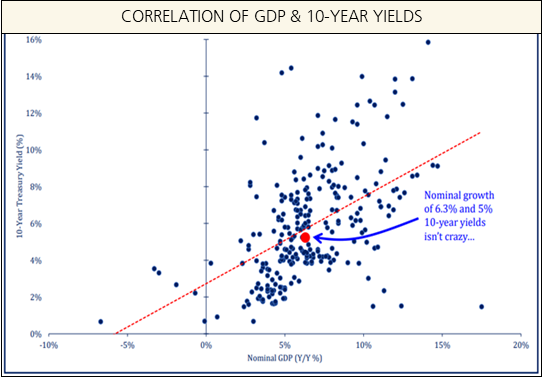
However, investors should also consider if a meaningful portion of recent rate moves reflect better economic growth. After all, a longstanding rule of thumb suggests that the 10-year Treasury yield should roughly track nominal GDP growth (including inflation). With the Atlanta Fed forecasting nominal GDP growth of 8.4% for the third quarter, that perspective may be gaining credibility (see scatterplot chart at end of article).
Business investment remains robust, particularly around artificial intelligence and related infrastructure. And those investments are not expected to conclude anytime in the short-term. If that investment eventually translates into greater productivity, the economy’s potential growth rate could rise as well. The late 1990s offer an interesting comparison. Rapid technology investment and accelerating productivity coincided with relatively high interest rates, yet strong economic growth and rising corporate profits allowed stocks prices to ascend.
We cannot know whether today’s economy is entering a similar period. Still, the question surrounding 5.3% Treasury yields is not simply, “How can the economy survive rates this high?” Perhaps it is also, “Why does an economy facing rates this high continue to grow so well?”
The more constructive interpretation (a new higher level of economic growth) does not eliminate risks long-term, but it does provide fundamental support to the idea that the current bull market still has room to run. Monetary policy works with a lag, and the Fed is tightening again while markets independently impose more restrictive conditions through higher Treasury yields, mortgage rates, and corporate borrowing costs. Eventually, higher rates can expose excessive leverage or business models dependent on inexpensive capital.
For this reason, we should watch credit markets closely. Corporate credit spreads measure the additional yield investors demand to lend money to companies rather than the federal government. When concerns about defaults, liquidity, or financial stress rise, those spreads typically widen. If rates continue higher while credit spreads remain contained, employment stays resilient, and corporate earnings grow, the economy may simply be demonstrating a greater capacity to withstand higher rates than investors expected. For the time being, credit spreads remain contained and earnings are strong.
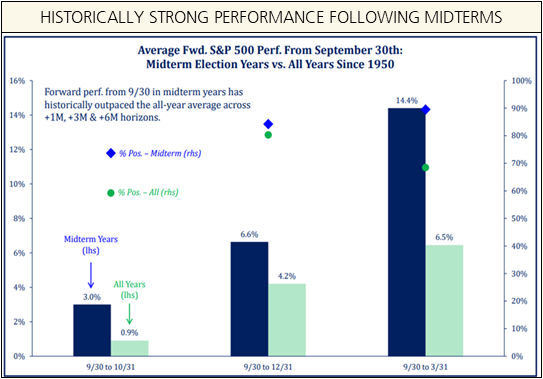
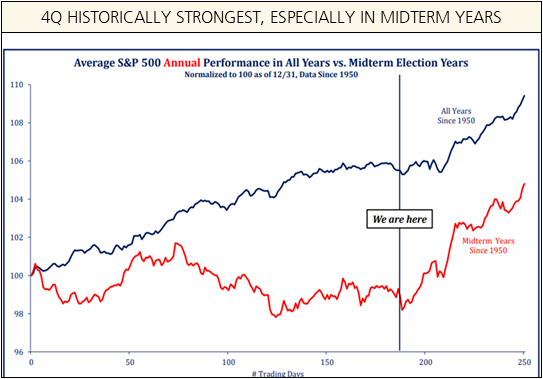
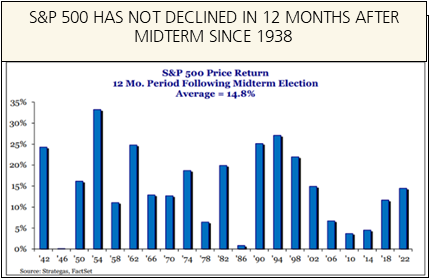
It’s noteworthy that midterm election years historically produce elevated volatility. But what occurs after election day is encouraging. Since 1938, the S&P 500 produced a positive return in every 12-month period following the election (Nov to Nov), with an average gain of roughly 14.8%. History does not guarantee a repeat; earnings, economic growth, inflation, and interest rates ultimately matter far more. Perhaps there is a fundamental case to accompany the historical “seasonal” evidence (midterm charts on page 4) as we conclude 2026 and enter 2027.
September gave investors plenty of reasons for caution. History suggests there remains runway for this bull market.
Fear of the Unknown
For the past several years, the investment conversation surrounding artificial intelligence focused almost entirely on its potential. More recently, the conversation is shifting and there is a notable increase in anxiety surrounding AI, ranging from job displacement and regulation to concerns about how quickly (and safely) the technology is advancing.
Fear of transformational technology is not new. Great concern developed among farmers about railroads in 1873 (image credit: The Daily Graphic). Automobiles disrupted horse-drawn transportation. ATMs threatened bank tellers. The internet challenged traditional retail, publishing, and countless other industries. Each innovation displaced some jobs and business models while creating others that were difficult to envision beforehand.

AI will almost certainly create its own winners and losers. But there is another dimension to the current debate that matters to investors. Artificial intelligence exists in the digital world, but building it requires enormous amounts of physical infrastructure.
Data centers require land, electricity, cooling systems, semiconductors, transmission capacity, industrial equipment, commodities, skilled labor, and enormous amounts of capital. That creates an interesting paradox. There is a strong case that AI will ultimately prove deflationary by making workers and businesses more productive. But building the infrastructure required to achieve those productivity gains will create inflationary pressure along the way.
The AI narrative appears to be entering a new phase. The first question was possibility: What can AI do? The next became opportunity: How large could the economic and investment opportunity become? Increasingly, the questions are focused on costs: How much to build, and the eventual economic implications. The public is becoming more skeptical, which is creating political debate. This does not diminish AI’s potential but it raises the hurdle.
Capital spending eventually needs to generate revenue. Revenue needs to produce profits. And profits ultimately need to justify price. Technological revolutions rarely travel in a straight line. AI will likely bring extraordinary successes, disappointments, excess investment, regulatory battles, and plenty of fear along the way. Like it or not, the current cycle does depend on continued spending for adoption of AI and the buildout of infrastructure to facilitate its full use. Pause to this spending could cause the market to stall.