Twist and Shout! | Steve Henderly, CFA
Printer Friendly PDF: September 2026 Commentary
The final song of The Beatles debut album, Twist & Shout, was recorded on a single take at the end of a very long day. John Lennon was fighting a bad cold and his voice was nearly shot. Despite these challenges, in that single take, John delivered one of the finest vocal recording of all-time! The song is upbeat, powerful, and full of raw energy.
Financial markets continued to provide reason for investors to both twist and shout in August. In a somewhat surprising twist, The U.S. Treasury announced it would expand purchases of longer dated Treasury securities, a move reminiscent of the Federal Reserve’s “Operation Twist” back in 2011. Bond yields rose and prices declined. On the other hand, stocks continued to move higher and the S&P 500 established several new record highs, causing some investors to shout with joy. With that as our backdrop, here are the things we think mattered most in August:
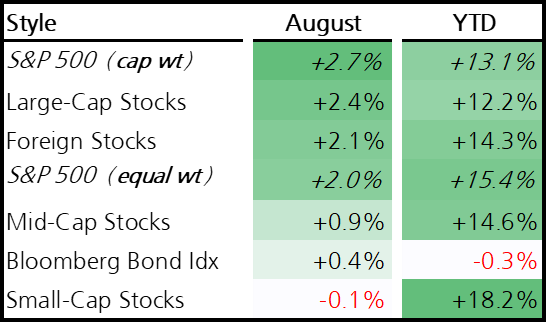
SHOUT! FEMO: Fabulous Earnings MOmentum is a term investors are using to explain the market’s continued ascent. The S&P 500 established four new highs in August, and was up +2.7% for the month. Client portfolios also enjoyed new record heights. With year-to-date performance so attractive, it’s natural to wonder whether enthusiasm is getting ahead of itself. Amazingly, the rapid +50% earnings growth this year, double expectations, is faster than the rise of stock prices. That means the S&P 500 price-to-earnings (P/E) ratio is actually lower now than it was entering the year (20.5x today vs. 22x). Corporate profits support the rise in stock prices.
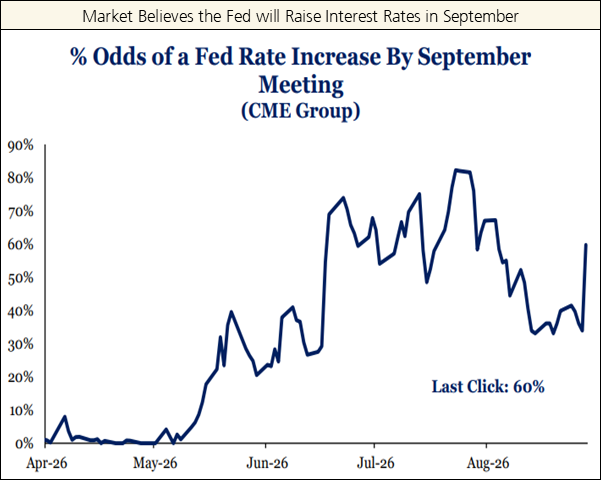
TWIST! When do deficits matter? While stocks were setting records, U.S. federal debt surpassed $40 trillion, and the 30-year Treasury yield reached its highest level in nearly two decades. Against that backdrop, Treasury Secretary Bessent’s decision to expand buybacks of longer dated government securities was especially noteworthy. By creating an additional buyer, the Treasury intends to provide stability and limit upward pressure on longer term yields. At the same time, debate continues whether the Fed will raise short-term interest rates when it next meets in September. Lifting short rates, while keeping longer-term rates roughly stable is the “twist”.
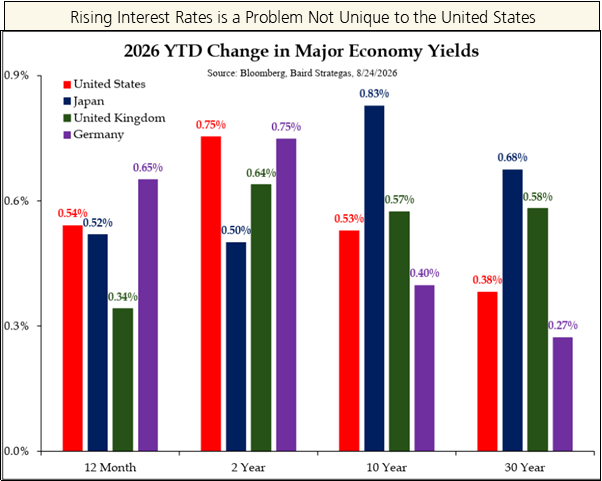
Why is greater intervention or support of longer-term debt becoming necessary? Most economists agree that government spending is too high and there seems to be little discipline by either political party to address it. There is ultimately a limit, and the bill could eventually come due through higher inflation, higher borrowing costs, or some combination of both. Yields trending higher in 2026 is not a phenomenon unique to the United States. Other large economies, including Japan, Germany, and the UK, are also experiencing a noticeable rise in government bond yields, as highlighted in the chart on page 2. While the Treasury Department can influence the bond market through their interventions, policymakers cannot permanently repeal the laws of supply and demand. History shows that policy alone cannot suppress market reactions indefinitely.
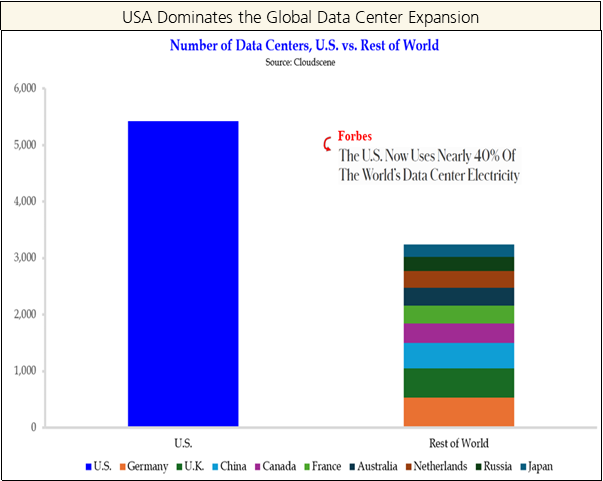
Twist OR Shout? Inflation vs. Productivity: This current economic cycle is somewhat different in that it’s being driven by capital expenditures rather than consumer spending. Businesses are spending aggressively on artificial intelligence, data centers, manufacturing, power generation, and infrastructure. That creates enormous demand for semiconductors, copper, electricity, construction materials, and skilled labor. In the short run, it’s creating additional inflationary pressures. In the long run, these investments should provide a boost to productivity and efficiency, which could be deflationary.
We’re already seeing evidence of improving efficiency through expanding corporate profit margins. The question is whether productivity gains can outrun the inflationary pressures created by the massive infrastructure buildout required to produce them. If so, the economy can grow faster without rising inflation. If not, higher inflation and interest rates could pose a meaningful constraint on future economic and profit growth.
Twist OR Shout? Pause vs. Hike: Despite all the discussion this year surrounding the Federal Reserve and anticipated next actions throughout 2026, the Fed has not adjusted interest rates since December 2025. Investors began the year widely anticipating multiple rate cuts. Today, the financial media narrative is increasingly criticizing Fed Chairman Kevin Warsh for not hiking interest rates.
Chairman Warsh continues to emphasize price stability, with the Fed targeting 2% core inflation, which could ultimately require tighter short-term interest rates. The war with Iran complicates the picture, but we wonder if the Fed might remain on hold for the balance of 2026. Longer term borrowing costs and mortgage rates may already be restrictive. If true, financial markets are already doing much of the Fed’s tightening for them. Price stability concerns could significantly ease with a lasting resolution to the Strait of Hormuz, delivering relief to oil prices. Should inflation accelerate from current levels while economic growth and corporate profits remain strong, the argument for higher short-term rates becomes more compelling. That makes September’s Fed decision (hold or hike) a close call.
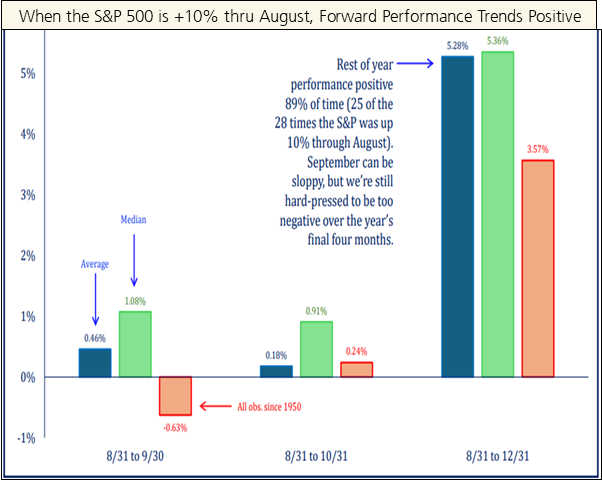
The bottom line: August provided investors plenty to joyfully “shout” about. Stocks reached new highs, earnings continue to be exceptional, business investment shows no signs of slowing, and productivity is improving. September carries a weak reputation, so do not be surprised if the market needs to digest YTD gains. However, it’s historically rare for the market to make its high for the year in August (chart below).
The “twists” taking place in the bond market are also important. Federal debt is increasingly part of the conversation and can no longer be viewed as an abstract number without consequence. The Treasury may be able to influence longer term yields through buybacks, but it cannot permanently eliminate the economic consequences of borrowing, inflation, or supply and demand.
Like John Lennon at the end of a very long day, sometimes the key is simply to recognize what’s working, acknowledge the challenges, and keep bringing the energy. August gave investors plenty to “Twist & Shout” about. We’ll see what’s in store for September and the balance of 2026!