Groundhog in July | Steve Henderly, CFA
Printer Friendly PDF: August 2026 Commentary
Most are familiar with the movie Groundhog Day. In the film, Bill Murray’s character, Phil, is doomed to repeat the same day over and over. Every morning he wakes up to Sonny & Cher’s “I Got You Babe”, the same weather report, the same conversations, and the same problems. Entering the month, it seemed many of the biggest worries facing investors were beginning to fade into the background, only to return simultaneously and in full. In fact, while trying to think of a clever title for this month’s commentary, I realized several we used in recent months could easily be recycled and would be just as fitting today. Instead of celebrating “Christmas in July”, the market felt a bit like celebrating “Groundhog in July”.
 Entering the month, many believed the worst of inflation was behind us as oil prices bottomed under $70 per barrel. But the ceasefire with Iran didn’t last long, and oil prices quickly rebounded toward $100 per barrel suggesting inflation is likely to remain stubbornly above the Federal Reserve’s stated target of 2%. Interest rates, specifically 10-year Treasuries, rose toward levels that consistently challenged markets over the past several years. Tariffs resurfaced as a core ingredient in the financial headlines with new proposals creating fresh uncertainty and another layer of complexity for the inflation outlook. Even artificial intelligence – arguably the market’s biggest growth story – is again the subject of renewed skepticism. Investors are asking whether the enormous capital being deployed today will ultimately generate equally enormous returns tomorrow. Meanwhile, the AI infrastructure buildout is contributing its own inflationary pressure in commodities and computer components. These storylines on their own are not new, but they all seem to be bubbling together as we enter August.
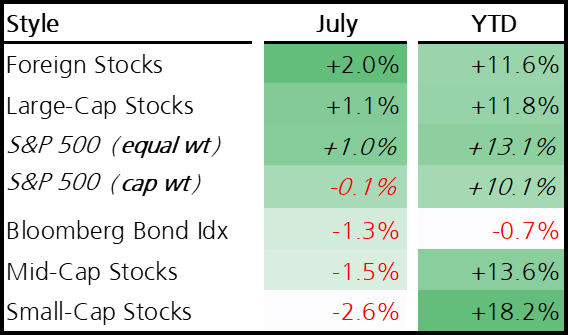
Investors appear to be more measured in their reaction to these issues in July. Rather than brashly reacting to every headline as though it represents a brand-new threat, the market seems increasingly willing to distinguish between uncertainty and catastrophe. That’s an important development. While the headlines may feel like Groundhog Day, the market’s response is gradually evolving. All things considered, the flat return in July by the S&P 500 feels pretty heroic!
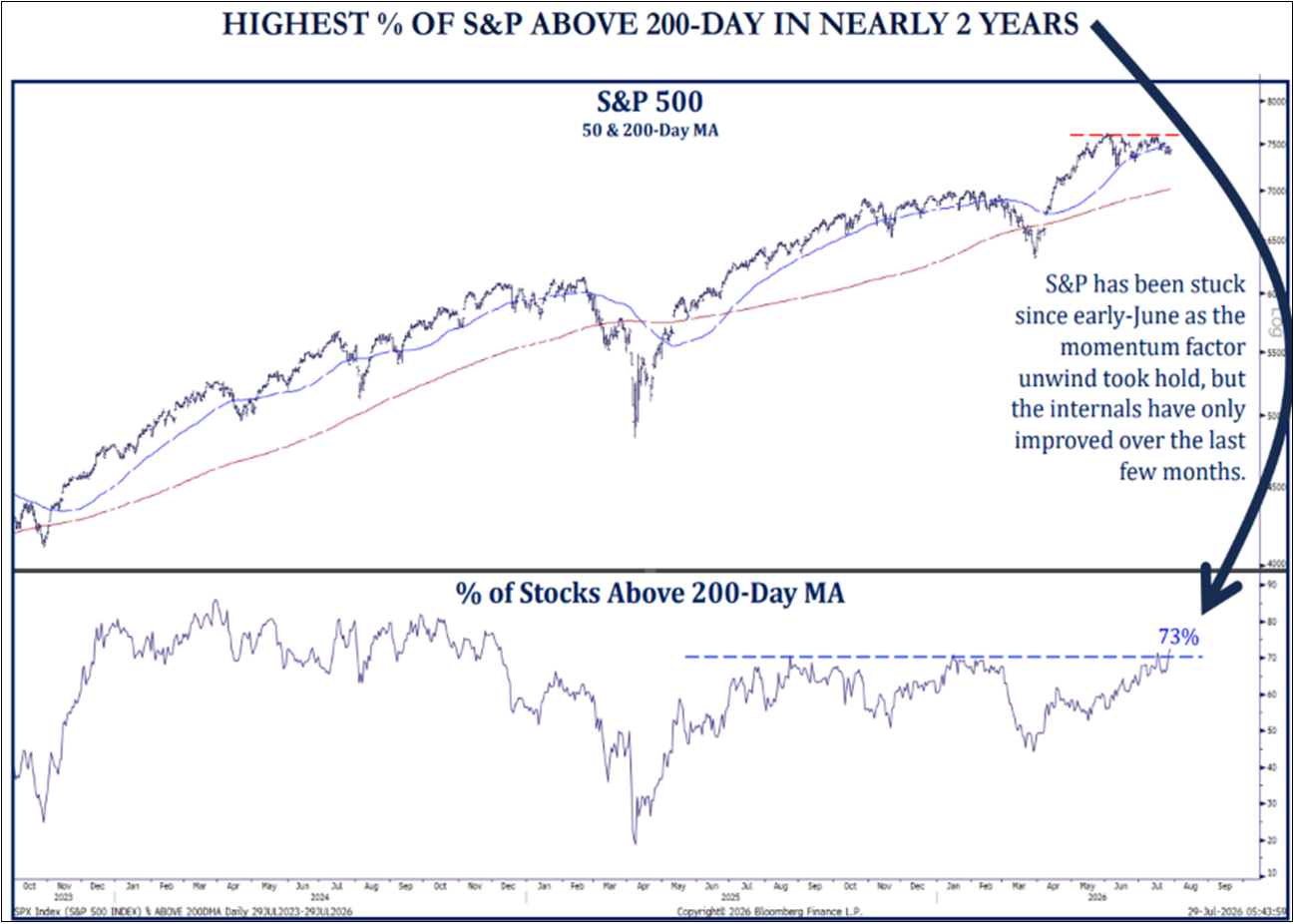
The S&P 500 did not log any new highs in July (until August 3rd; the last record high occurred on 6/2), largely trading sideways near its 50-day moving average. Not coincidentally in our view, the 10-year Treasury yield hovered around or above 4.5%, while the 30-year Treasury rose to and currently remains above 5%. That is the longest stretch above 5% since 2007. In our view, this is simply the latest reminder that today’s higher interest-rate environment remains a meaningful hurdle for equity valuations, even when corporate fundamentals such as cash flow and earnings are robust.
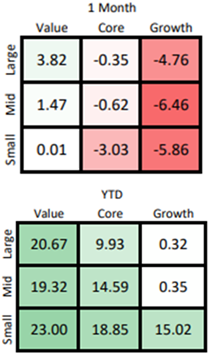
Looking deeper, while the stock market was generally soft in June and July, there significant rotation between winners and slow performers. Corporate earnings are remarkably strong. It is encouraging that the broader market is quietly outperforming the mega-cap technology stocks, continuing the rotation we observed during the final months of 2025 and early 2026. The average stock – and the more value-tilted stock exposure within client portfolios – is performing better this summer than the top-heavy, cap-weighted indexes. Unlike the S&P 500, client portfolios achieved several new all-time highs during July. Entering July, 62% of stocks in the S&P were trading above their 200-day moving average; that number expanded (broadening participation) to finish the month near 70%. Small size companies are experiencing their best start to a year since 1991. International stocks enjoyed an attractive advance in July despite the renewed uncertainty in the Middle East. That’s encouraging for investors who continue to believe that excessive concentration in a handful of companies and sectors creates unnecessary long-term risk.
One theme we’re watching closely is the relationship between interest rates and overall financial conditions. At the July meeting, the Federal Reserve again held its policy rate steady. The financial markets may already be doing much of the Fed’s work to address inflation and levels of government debt. Mortgage rates climbed to their highest level in over a year, around 6.7%, while gasoline prices moved back to roughly $4 per gallon. Historically, when these two figures add up to more than 10, household budgets begin to feel strain. In many respects, financial conditions already feel restrictive.
That helps explain why the bond market may be sending a more measured message than many investors appreciate. Although expectations for another Fed rate hike remain elevated in some corners of the market, inflation expectations and forward interest-rate pricing suggest policymakers could remain on hold unless inflation accelerates meaningfully. Higher energy prices can do some of the Federal Reserve’s work by tightening financial conditions, potentially reducing the need for further rate increases.
 Consumer spending, and GDP, is expected to slow from the torrid pace experienced earlier this year as tailwinds from tax refunds, the World Cup, and America’s 250th anniversary celebrations begin to fade. Even so, this appears to remain a capital expenditure-driven economic cycle more than a consumer-driven one. Businesses are investing aggressively in technology, infrastructure, manufacturing capacity, and productivity enhancements. As long as those investments continue, the economy retains an important source of support that distinguishes this expansion from many previous cycles.
Sentiment remains another widespread concern, with many casual investors believing the market is expensive after such a strong first half of the year. Ironically, valuations are more attractive than many realize. Year-to-date earnings growth approaching 30% compressed valuation multiples, with the S&P 500’s price-to-earnings ratio declining from roughly 23x at the beginning of 2026 to about 19.5x entering August. That’s an important reminder that stock prices alone never tell the entire story. Markets become expensive when prices outrun fundamentals. This year, fundamentals are doing the heavy lifting.
Looking forward, an important question is what happens if earnings growth begins to slow; can current high earnings growth rates continue? Consensus expectations remain extraordinarily strong through 2027, and history suggests markets struggle when the rate of improvement begins to moderate. Forward earnings expectations are increasingly ambitious, making disappointment more likely.
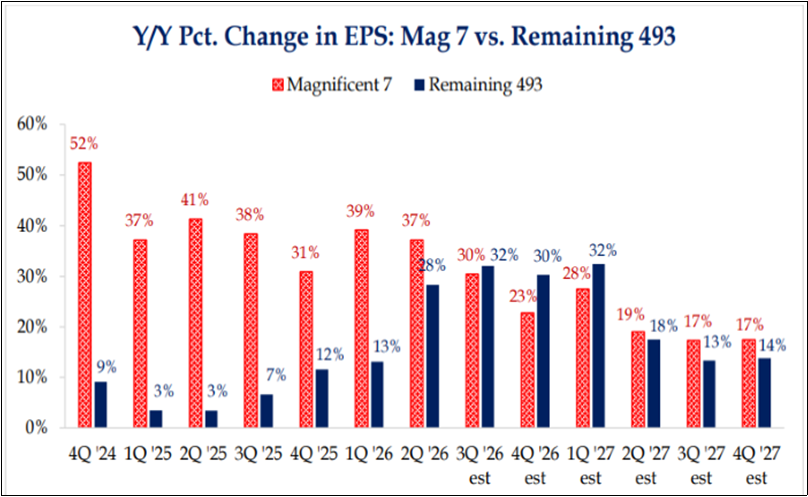
Artificial intelligence sits squarely at the center of this discussion. For the better part of two years, investors focused almost exclusively on how much companies were spending on AI. Increasingly, however, the conversation is shifting toward whether those investments will ultimately generate acceptable returns. It also appears investors are rotating to other market sectors with lower valuations (value style). That’s a healthy evolution and helps explain why many of the Mag7 stocks are struggling to make meaningful progress in recent months. Every transformational technology requires significant upfront investment, but not every dollar invested ultimately earns an attractive return. The question is no longer whether AI will change the world, but whether today’s market expectations already reflect that future success.
So where does that leave investors as we enter August? The headlines look familiar and it may feel as though storm clouds are gathering. Inflation. Interest rates. Oil. Tariffs. Geopolitical conflict. Souring consumer sentiment. Questions about technology valuations. It’s easy to feel like we’re waking up to the same challenges over and over again. But that’s not really the lesson of Groundhog Day. The lesson isn’t that nothing changes. It’s that success comes from responding differently to circumstances that inevitably repeat themselves. Markets will always provide reasons to worry. The headlines change, but uncertainty itself never goes away. Successful investing is not about waiting for the news to become comfortable. It’s about remaining disciplined, staying invested in attractively valued areas.
Historically, August and September can be challenging months, particularly during midterm election years. Businesses adapt. Consumers adjust. Markets recalibrate. Like Bill Murray waking up to the same alarm clock each morning, investors often wake up to familiar market fears dressed in new headlines. Staying disciplined remains one of the few advantages they can consistently control.