The Air in the Bag | Steve Henderly, CFA
Printer Friendly PDF: November 2026 Commentary
Sealing air inside a bag of potato chips serves a purpose. It protects the deliciously salty snack from becoming a pile of crumbs. Over the last several years, enthusiasm for artificial intelligence provided a similar cushion for stocks, especially semiconductor “chips” and the technology giants building AI infrastructure. The prevailing view was that the growth opportunity was so compelling that even higher interest rates would do little to slow it. Is some of the air starting to escape the bag?
We see October’s reassessment as healthy. Interest rates are a bit like gravity in investing. Even businesses with strong growth prospects feel the drag. As inflation and borrowing costs are elevated, it appears investors are beginning to ask more pointed questions about how much AI spending companies can justify. Here’s what stood out in October.
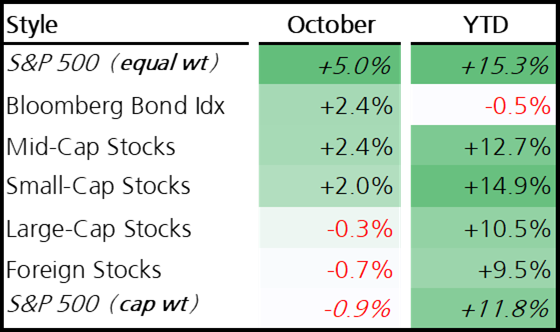 October’s market rotation: October brought a sharp shift in market leadership. The market-cap-weighted S&P 500 declined 0.9%, while the Nasdaq Composite fell 5.3%, its weakest month since March 2025. Weakness in the largest technology companies weighed on performance. The top 10 companies now represent 41% of the S&P 500’s market capitalization.
Broader market performance was considerably stronger. The equal-weight S&P 500 gained 5.0%, midcaps rose 1.9%, and small caps advanced 0.6%. Market breadth improved significantly, with 62% of S&P 500 stocks finishing the month above their 200-day moving average, up from 43% in September. International results were mixed, and bonds stabilized as yields eased slightly. For diversified investors, the shift in leadership helped widen the year-to-date performance advantage over the traditional cap-weighted S&P 500.
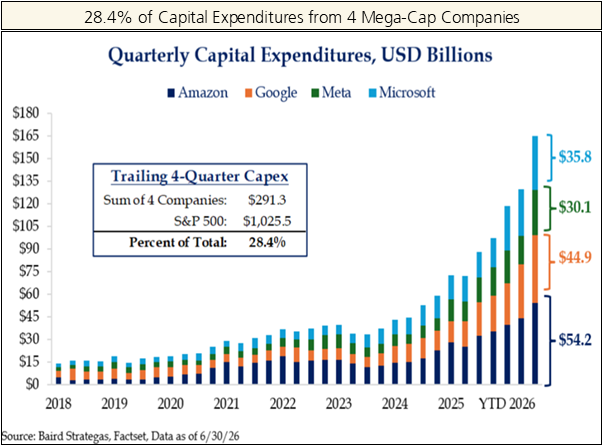
Does the cost of money still matter for AI? It’s undeniable that the largest technology companies possess substantial financial resources, and projects with attractive expected returns can withstand higher borrowing costs. Even so, as additional capital is required and interest rates rise, borrowing expenses require more revenue (and profit) to justify all the investment.
Gartner, a leading technology research firm, estimates that AI data center owners would need $8.5 trillion in revenue through 2030 to cover investments and earn a reasonable return. Yet projected revenue falls well short, at no more than $3.6 trillion. While these are estimates based on assumptions, the gap raises legitimate questions about whether today’s massive AI investments will pay off. Investors are increasingly scrutinizing spending, financing and valuations. While the AI opportunity remains significant, selectivity is becoming more important.
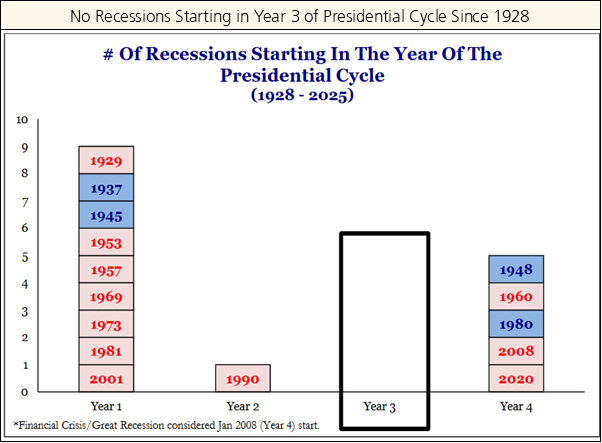
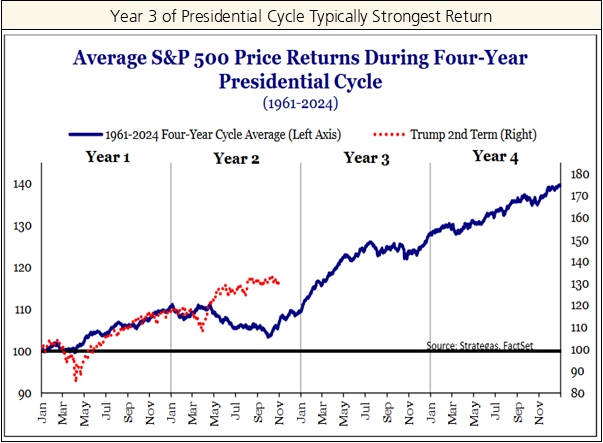
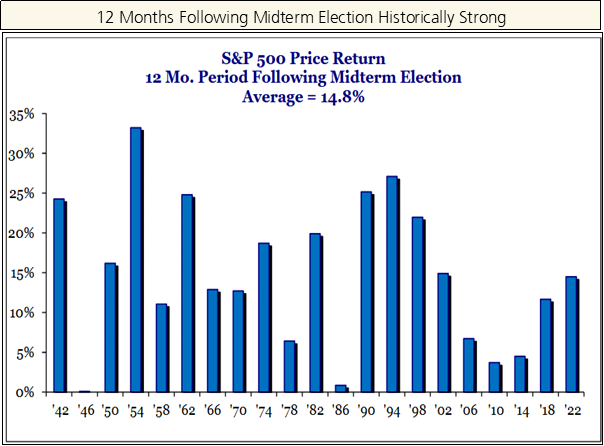
Midterms take one uncertainty off the table: Let’s all be grateful for the promise of fewer campaign ads, texts, and calls – at least for a few months! We often hear concerns from clients around elections and results, but history strongly supports the idea that markets are not partisan. Markets dislike uncertainty, and as election results become clear, investors can better judge who controls Congress and which policies stand a realistic chance of advancing. The S&P 500 produced a positive return in the 12 months following each midterm election since 1938. Historically, the third year of a presidential term has been the best for investors, with the strongest average stock returns and no recession ever beginning during that year (charts). With that said, midterm election years are notoriously more volatile, experiencing average intra-year declines of approximately 19% compared to 13% all other years. Against that historical backdrop, market volatility in 2026 remained subdued, but there’s been no shortage of unease.
Divided government is believed to narrow the scope for major legislative changes. Data centers still raise a question of their own. Concerns about utility bills and the impact on local communities cross party lines. Could those shared concerns lead to tighter requirements or slower approvals even if Washington is gridlocked? This again links back to the idea that the protective “air in the bag” may be getting thinner.
Earnings and the Fed: Corporate profits continue to support the bull market. At October’s close, FactSet estimated 3Q S&P 500 earnings growth of 30% from a year earlier. However, strength in earnings and economic activity does give the Fed room to keep fighting inflation. As expected so close to the midterm election, the Fed voted 10 to 2 to hold rates steady in October, but with inflation still elevated, investors anticipate a December hike and further tightening in the first half of 2027. A durable resolution to the conflict with Iran could ease energy prices, relieving pressure on both households and the Fed. For market valuations to remain attractive, it is important that corporations achieve forecasted earnings growth as we enter 2027.
Bonds still face challenges, but TINA gives way to TARA: During the decade of near-zero rates following the financial crisis, TINA (There Is No Alternative) was a familiar argument for owning stocks. At current yield levels, bonds offer competitive income, and TARA (There is a Reasonable Alternative) better describes the choices investors face. Higher yields also raise the bar for stocks priced on ambitious future earnings.
In Summary: We remain optimistic for the balance of 2026 and for continued economic growth in 2027. As election uncertainty recedes, strong corporate profit expectations give investors reason to look beyond the recent weakness in technology. October showed how a wider range of companies can contribute when the biggest names stumble. Some air may be coming out of the AI trade, but opportunities remain. As adoption expands, productivity gains will benefit not just tech companies, but also the businesses using AI to improve efficiency and profitability. Staying invested while maintaining discipline on valuations remains key.